I am astonished by modern politics; that said I am not a student of political science so maybe I just don't get it.
I write this post following the re-election of President Obama.
I have always understood that the divide between political parties is characterised by their differing beliefs, and thus policies.
If this is true, why would supporters of President Obama and his policies, and politics, now anticipate that consensus and collaboration by both major political parties should prevail to help implementation of policies that are not universally embraced? Politicians who do not share the views of the elected government are typically said to be in opposition because in general they more oppose than concur with the policies of the elected government.
So why, for the 'good of the country' as so many Democratic supporters now want to claim, should Republicans now defer to Democratic party policies? Wouldn't that be a complete betrayal of their convictions? The same question is relevant for political parties in any democracy.
John F Kennedy's speechwriter and special counsel Ted Sorensen wrote: 'A candidate who trims himself to fit the notions of every group will soon whittle himself down to nothing'.
Perhaps in today's disposable world convictions no longer matter? Perhaps the willingness of past politicians to set aside their convictions has led to today's environment in which no clear and strong leadership from either political parties or individuals emerge? Is this why politics is now driven by charisma and spin?
I could understand that if a significant majority were unified behind one party then the policies of that party could be considered pre-eminent; but if such were the case would not the entire machinery of government be in the hands of a single party? But such is not the case in America.
So what has the political situation in America got to do with me? As an Australian should I care? I believe I should for two reasons.
Why I care #1. I care because the affairs of America, like it or not, influence the entire globe and thus my own future rests to some degree in the hands of some people and successive governments that have contributed to accruing a 16 trillion dollar debt; and this newly returned government in America will almost certainly continue to increase this unimaginable, and ultimately unsustainable, debt. That, folks, is going to affect all of us, irrespective of where we live and vote, at some time in the future, and a future not too far off I suspect.
Why I care #2. I also care because the Australian political landscape is tainted with a circumstance similar to that of America. Our own government, an illegitimate minority party government, is continuously pleading those in opposition to support the implementation of policies which are clearly not consistent with opposition policies. So why then do government ministers continue to browbeat opposing politicians into supporting policies for which they have no stomach? And why do populist commentators and numerous citizens continually criticize the leader of Australia's opposition party for opposing government policies that he does not believe in, or agree with?
Now lest you believe I am just being politically partisan I should clarify my core concern, which is that politicians, of any political persuasion who are without conviction, are diminishing the essence of democracy .
I see a future in which conviction is no longer part of the political process. I fear for the future of democracy. I fear for Australia's future as a democracy.
Sunday, 18 November 2012

Tuesday, 6 March 2012
'Thank God I'm on the way out and not on the way in. '
This was emailed to me yesterday; I think there's some very important issues worthy of
the widest consideration:
Bill Cosby says: "I'm 76 and I'm Tired"
I'm 76. Except for brief period in the 50's when I was doing my National
Service, I've worked hard since I was 17. Except for some serious
health challenges, I put in 50-hour weeks, and didn't call in sick in nearly
40 years. I made a reasonable salary, but I didn't inherit my job or my
income, and I worked to get where I am. Given the economy, it looks as
though retirement was a bad idea, and I'm tired. Very tired.
I'm tired of being told that I have to "spread the wealth" to people who
don't have my work ethic. I'm tired of being told the government will take
the money I earned, by force if necessary, and give it to people too lazy
to earn it.
I'm tired of being told that Islam is a "Religion of Peace," when every day I
can read dozens of stories of Muslim men killing their sisters, wives and
daughters for their family "honor"; of Muslims rioting over some slight
offense; of Muslims murdering Christian and Jews because they aren't
"believers"; of Muslims burning schools for girls; of Muslims stoning
teenage rape victims to death for "adultery"; of Muslims mutilating the
genitals of little girls; all in the name of Allah, because the Qur'an and
Shari'a law tells them to.
I'm tired of being told that out of "tolerance for other cultures" we must let
Saudi Arabia and other Arab countries use our oil money to fund mosques
and madrassa Islamic schools to preach hate in Australia , New Zealand ,
UK , America and Canada , while no one from these countries are allowed to
fund a church, synagogue or religious school in Saudi Arabia or any other
Arab country to teach love and tolerance..
I'm tired of being told I must lower my living standard to fight global
warming, which no one is allowed to debate.
I'm tired of being told that drug addicts have a disease, and I must help
support and treat them, and pay for the damage they do. Did a giant germ
rush out of a dark alley, grab them, and stuff white powder up their noses
or stick a needle in their arm while they tried to fight it off?
I'm tired of hearing wealthy athletes, entertainers and politicians of all
parties talking about innocent mistakes, stupid mistakes or youthful
mistakes, when we all know they think their only mistake was getting
caught. I'm tired of people with a sense of entitlement, rich or poor.
I'm really tired of people who don't take responsibility for their lives and
actions. I'm tired of hearing them blame the government, or discrimination
or big-whatever for their problems.
I'm also tired and fed up with seeing young men and women in their teens and
early 20's be-deck themselves in tattoos and face studs, thereby making
themselves un-employable and claiming money from the Government.
Yes, I'm damn tired. But I'm also glad to be 76.. Because, mostly, I'm not
going to have to see the world these people are making. I'm just sorry for
my granddaughter and her children. Thank God I'm on the way out and not
on the way in.
Bill Cosby says: "I'm 76 and I'm Tired"
I'm 76. Except for brief period in the 50's when I was doing my National
Service, I've worked hard since I was 17. Except for some serious
health challenges, I put in 50-hour weeks, and didn't call in sick in nearly
40 years. I made a reasonable salary, but I didn't inherit my job or my
income, and I worked to get where I am. Given the economy, it looks as
though retirement was a bad idea, and I'm tired. Very tired.
I'm tired of being told that I have to "spread the wealth" to people who
don't have my work ethic. I'm tired of being told the government will take
the money I earned, by force if necessary, and give it to people too lazy
to earn it.
I'm tired of being told that Islam is a "Religion of Peace," when every day I
can read dozens of stories of Muslim men killing their sisters, wives and
daughters for their family "honor"; of Muslims rioting over some slight
offense; of Muslims murdering Christian and Jews because they aren't
"believers"; of Muslims burning schools for girls; of Muslims stoning
teenage rape victims to death for "adultery"; of Muslims mutilating the
genitals of little girls; all in the name of Allah, because the Qur'an and
Shari'a law tells them to.
I'm tired of being told that out of "tolerance for other cultures" we must let
Saudi Arabia and other Arab countries use our oil money to fund mosques
and madrassa Islamic schools to preach hate in Australia , New Zealand ,
UK , America and Canada , while no one from these countries are allowed to
fund a church, synagogue or religious school in Saudi Arabia or any other
Arab country to teach love and tolerance..
I'm tired of being told I must lower my living standard to fight global
warming, which no one is allowed to debate.
I'm tired of being told that drug addicts have a disease, and I must help
support and treat them, and pay for the damage they do. Did a giant germ
rush out of a dark alley, grab them, and stuff white powder up their noses
or stick a needle in their arm while they tried to fight it off?
I'm tired of hearing wealthy athletes, entertainers and politicians of all
parties talking about innocent mistakes, stupid mistakes or youthful
mistakes, when we all know they think their only mistake was getting
caught. I'm tired of people with a sense of entitlement, rich or poor.
I'm really tired of people who don't take responsibility for their lives and
actions. I'm tired of hearing them blame the government, or discrimination
or big-whatever for their problems.
I'm also tired and fed up with seeing young men and women in their teens and
early 20's be-deck themselves in tattoos and face studs, thereby making
themselves un-employable and claiming money from the Government.
Yes, I'm damn tired. But I'm also glad to be 76.. Because, mostly, I'm not
going to have to see the world these people are making. I'm just sorry for
my granddaughter and her children. Thank God I'm on the way out and not
on the way in.
Monday, 27 February 2012
The gentrification and monetization of paradise
For a few days I've been visiting friends in Noosa Heads, a one-time
hamlet or village clustered on an idyllic coastline north of Brisbane,
Australia; this is where I made my home in the early nineteen eighties;
when I lived here all the streets, with the exception of main
thoroughfares, had grass verges, and dusty casuarina, eucalypts,
banksias, acacias, melaleucas, sheoaks, and drooping pandanus were the
predominant flora; now manicured lawns, smart combinations of terrazzo
pavers and gravel, and palms and other lush topic plantings have elbowed
their way into this Australian seaside town. Now it's as if a town
planning manual had exploded.
 Nowhere is this gentrification more obvious that in the jewel of the
town, Hastings Street, the town's boutique shopping heart; I can't deny
that to walk along this tiny narrow strip, squeezed serendipitously
between the ocean and the Noosa River, with its idyllic pools of flame
trees shadow, is a delight; there was a time when my life centred on
plans for converting Hastings Street into an alternative version of what
it has become, but what has been done, without my help or hindrance, is
beautiful. You should come and visit this place if you are in
Australia.
Nowhere is this gentrification more obvious that in the jewel of the
town, Hastings Street, the town's boutique shopping heart; I can't deny
that to walk along this tiny narrow strip, squeezed serendipitously
between the ocean and the Noosa River, with its idyllic pools of flame
trees shadow, is a delight; there was a time when my life centred on
plans for converting Hastings Street into an alternative version of what
it has become, but what has been done, without my help or hindrance, is
beautiful. You should come and visit this place if you are in
Australia.
But as is often the case, there are storm clouds, every bit as large and spectacular as those that loom on summer nights, building and billowing, and the breezes are turning to gales.
Now with the high Australian dollar making cheaper-than-ever-before international holidays, tourism in the town is, unlike the luxuriant tropic plants, wilting, and this, together with the Australian economy, which has a sniff of uncertainty about it, means that while every house and apartment in town is for sale, buyers are fewer than in boom times, and they are more opportunistic.
There are many dreams at stake here; good people whose imagination was captured by the the white light, the turquoise ocean, the golden sands, the forest green of the headlands, the warm fragrant evenings, and by the promise of an easy lifestyle, dreamed of settling - and many came to stay. And for some those realised dreams of sumptuous residences, eye-pleasing vistas, and pristine neighbourhoods have the potential to become nightmares as times inevitably turn and circumstances change.
The gentrification of paradise; it's said to be progress. But now I wonder.

But as is often the case, there are storm clouds, every bit as large and spectacular as those that loom on summer nights, building and billowing, and the breezes are turning to gales.
Now with the high Australian dollar making cheaper-than-ever-before international holidays, tourism in the town is, unlike the luxuriant tropic plants, wilting, and this, together with the Australian economy, which has a sniff of uncertainty about it, means that while every house and apartment in town is for sale, buyers are fewer than in boom times, and they are more opportunistic.
There are many dreams at stake here; good people whose imagination was captured by the the white light, the turquoise ocean, the golden sands, the forest green of the headlands, the warm fragrant evenings, and by the promise of an easy lifestyle, dreamed of settling - and many came to stay. And for some those realised dreams of sumptuous residences, eye-pleasing vistas, and pristine neighbourhoods have the potential to become nightmares as times inevitably turn and circumstances change.
The gentrification of paradise; it's said to be progress. But now I wonder.
Wednesday, 4 January 2012
Hi Doe and Hi Boo.
Even in these times of increased terrorist danger, good-times, sun, sand and ocean still tend to foster easygoing environments - and yet even in such a paradise there are times when protection against all manner of events could be valuable.
Visitors and residents on the Thai island of Phuket
are very fortunate because on the crest of the timbered range that doglegs
along the southern end of Phuket island are two impregnable shields; each
protects against different enemies - each offers a different liberation.
This low range separates Phuket Island-east from
island-west: to the west is a string of sparkling bays and beaches extending
from Nai Harn Beach in the south to Surin Beach mid-way along Phuket’s Andaman
Sea coast; this side of the island is tourist heaven. On the other side of this
range you’ll find more locals, Thai cuisine as eaten by Thais, sleepy bays and
lazy villages, jetties, and Phuket Town, the administrative and industrial
centre for the island.
In today’s Thailand the hip, hop into cool
gobbledygook, like Hi-So and Lo-So – and I’m adding Hi-Doe and Hi-Boo to this
contemporary mumbo jumbo.
The first, Hi-Doe, introduces High Dome, a white globe
– a Thai military radar installation - located about mid-way between the northern
and southern ends of the island on Khao Mai Thao Sip Song, a peak that rises
530 metres above sea level. This dome is presumably sniffing for military
threats against Phuket and other parts of Thailand. Hi-Doe also frowns down on
Bangla Road, the strip in the centre of hedonist’s haven - Patong; if ever
there were a threat to holidaymakers, especially their wallets and purses, it
is almost certainly lurking in the temptations found on its streets and
laneways. But I imagine the radar is too busy searching the furthest horizons
to be snooping on holiday dalliances and furtive fumbling!
Hi-Doe perches just above one of two low saddles in
the range that opens east to west and through this gap stream trucks and
tuk-tuks, cars and cabs, and busses and bikes; not content with the high-tech
protection up above the majority of drivers and riders beep their horn for good
luck when passing a Chinese temple on the crest of the pass – you can never
have enough protection!
A visit to the high point near the radar station is
worthwhile – the near 360 degree views are spectacular – to the west the slope
cascades down to Patong with it’s spectacular bay, and to the beaches beyond.
To the south the views are along the range to where our second protective
device squats. And to the east there are spectacular views of Phuket Town,
Chalong Bay, and Phangha Bay dotted with weird limestone formations, and
islands.
Hi-Doe is reached by a narrow, steep and winding road
on the eastern side of the range; despite this the road is well surfaced and
graded and an attacking force would appreciate the high quality road that leads
to the gates of this military installation; if you visit the lookout, the radar
site is a little further up the hill – the armed guards are placid enough but
may not remain so if you take photographs.
At the opposite end of the range to Hi-Doe, at the
southern end, on peak Khao Nakkerd is a very different device - Hi-Boo, a tall
Buddha gazing serenely eastwards over Phuket Town and Chalong Bay.
According to the constructor’s web site the Buddha is
in honour of King Bhumiphol, and it’s to be a centre for beneficial influence
in Thailand, and particularly the Phuket community. Ultimately a beautiful
religious park with trees to provide shaded places for Buddhist teaching and
meditation will surround the Buddha. All Buddha statues represent the dharma -
the accumulated Buddha’s teachings and wisdom - and so I am content to imagine
the Buddhist message of compassion and peace radiating from the giant Buddha
out over the island.
I was keenly anticipating the advertised ‘big Buddha’
on my first visit and I was not disappointed by the 12 metres tall brass Buddha
featuring coiled, intertwined bodies of two naga, the Sanskrit word for
serpent. The Buddha’s polished surface reflected the sun and warm breezes
ruffled yellow Buddhist flags.
Wandering around I admired spectacular views - and
away to the north perched Hi-Doe. Sharing my dusty vantage point were numerous
workmen constructing a large concrete base encased in scaffolding and
eventually I realised that the Buddha I had been admiring was but the entrée so
to speak – this vast base is where the advertised Big Buddha image would
ultimately rest.
By mid 2007 the big Buddha, Phra
Puttamingmongkol Akenakkiri, was still under construction, rising 45 metres high -
that’s almost identical to the Statue of Liberty although the grand lady’s
taller pedestal increases her total height to 93 metres – both are tall - and
both are statues of liberty.
I am hoping the Big Buddha’s facial features will
reflect traditional Sukhotai or Ayutthaya era beauty – to my eye Thai artisans
have created features more pleasing than Indian or Oriental-styled Buddhas.
Sukhotai and Ayutthaya styled Buddhas typically have long faces, downcast eyes,
lengthened earlobes, and curly hair with a pointed flame ushnisha rising above
the head.
Buddhas come with an amazing diversity of visual
characteristics – in fact there are 32 great marks a Buddha can exhibit
including facial and physical attributes, stance, vestments and other items of
clothing, and ornaments.
The total cost of the Phuket Buddha will be 30 Million
Baht and, to help defray this cost, my own small contribution has been to buy a
marble tile upon which is written my name, my partner’s name and those of her
family; eventually this tile will become a tiny, permanent part of the floor
around the lotus base.
I know very little about building anything – let alone
a huge Buddha – but I imagine that its surrounding scaffold would have failed to meet
safety standards in countries where there is greater, or perhaps any, building
regulation. The tangle of pole scaffolding I observed on my first visit reached
perhaps three metres; now it rises tier upon tier seeming somehow to defy any
known structural discipline - and gravity; horizontal and vertical poles are
connected solely with rope and twine and many of the poles have protruding
stubs where branches have been chopped away.
Despite this apparent laxity and instability workmen
laughed and chatted as they leaped from platform to platform, men perched in pockets
where poles intersected or they balanced astride poles, and at the very top, where
numerous Thai and Buddhist flags fluttered in stiff breezes, men leaned over this
precarious scaffolding going about their work. Perhaps working on a Buddha
construction has powerful in-built protection?
Despite this web of poles I could see that concrete was
being smoothed over an internal steel mesh skeleton so, aside from the main
internal pillars, the Buddha is hollow; ultimately the Buddha will be enhanced
with golden mosaic.
Aside from concrete, traditionally manufactured
Buddhas of considerable size are formed from many materials including wood,
bronze, crystal, quartz, brick, stone, pottery, plaster – and there’s a solid
gold, three metres tall Buddha at Bangkok’s Wat Traimit weighing 5.5 tonnes;
for centuries this Buddha was thought to be made of plaster until one day,
while being moved, it was dropped, the plaster cracked, and the solid gold
Buddha beneath was revealed
The immense Phuket sitting Buddha competes with a
number of other large Buddhas.
In Thailand there are several competitors including a
24 metre tall bronze sitting Buddha that was, until now, the tallest in
Thailand; in the far north at Tha Ton a giant white Buddha gazes over the Kok
River and there’s a 68 metres tall standing Buddha in the Khorat Plateau town
of Roi Et.
In the ancient Siamese cities Sukhotai and Ayutthaya
there are large and beautiful Buddhas, and in Bangkok, there are several
including a 32 metres tall standing Buddha of absolutely no artistic merit; and
there’s the classically beautiful, 46 metres long reclining Buddha located in
quixotically exotic Wat Pho, the oldest and largest Wat in Bangkok.
There are others scattered across Thailand – but the
Phuket sitting, freestanding Buddha is now the largest of all. There is one
unusual competitor, a 109 metres tall standing Buddha etched into a Thai
mountainside.
In other places around the Buddhist world there are
giants to be found in Japan, South Korea, Sri Lanka, China and Hong Kong and
Myanmar. The largest of all is the 120 metres tall Ushiku Amida Buddha near
Tokyo, and in Leshan, China a Buddha carved in a sheer rock face reaches 71
metres; it took one hundred years to carve.
There were other large Buddhas equaling Hi-Boo’s size
including the great Bamiyan standing Buddhas in Afghanistan that were destroyed
by Taliban Islamic fundamentalists in 2001; the tallest was 55 metres.
Somewhat ironically, in India the land of Buddha’s
birth and a country in which Buddhism is now the belief of a tiny minority, a
large Maitreya Buddha – the Buddha of the future - is planned although
construction is currently stalled; the planned height of 150 metres rivals the
height of the great pyramid of Cheops. I’ve seen the pyramid, mysterious and
inspirational, and maybe I’ll look forward to seeing the competing Buddha – or
will I? Probably not!
Perhaps, unknown to those of us raised in non-Buddhist
cultures, these large Buddhas scattered across the globe may have some greater
purpose than the contribution they make to each locale – is it somehow possible
that together they suspend a mesh of goodwill and compassion across all
nations? It’s a nice thought.
Why build such Buddhas? Is bigger better? Perhaps not,
because many Buddhas considered as offering the greatest protection are also
among the smallest – tiny amulets or votive tablets featuring Buddha or monk
images are greatly revered and are worn by many.
The first time I ever went to Thailand I was invited
by a friendly bar girl (aren’t they all?) and friends to attend Loy Krathong
celebrations – and I was given my first votive tablet, a small grey-ish lozenge
with a Buddha image on one side. I have it still and I have added many tablets,
amulets, talismans and woven wristbands since.
Although amulets are sold and exchanged all over Thailand, perhaps
amulet-Mecca is found close-by the Grand Palace in Bangkok – this is where
serious searchers for protection against all manner of dangers hunt.

There is no question about which protective device –
Hi-Doe or Hi-Boo – dominates the Phuket skyline, Hi-Boo wins hands down – well
to be accurate, hand down because he sits in Maravichai style, the common and
classic pose, with one hand in his lap and the other hand draped over his right
leg with the fingers reaching for the earth; this pose reflects the moment of
his enlightenment.
From where I stay I can see this vast Buddhist aide-memoir
framed by forested slopes and tropic skies; seen from Chalong Bay jetty the
rising sun splashes the statue with a palette of gold, silver and pewter, and
at day’s end nature’s most spectacular blue skies fused, like a length of raw
Thai silk, with neon pink, mauve, and purple form a backdrop that somehow seems
inadequate to complement the sublime essence of the Buddha.
So, with all this written, is Phuket doubly protected?
And, if it is, what is it protected from? I suspect answers to these two
questions will differ depending on the cultural background of the respondent.
West and East will perceive different dangers and put their trust in different
defenses. Vive la difference! Or, as we say in Thailand, same-same but
different.
Sunday, 17 July 2011
I need to see some ID before you read this post.
Just joking.
If you’re reading this post then you’ve probably flicked through a few of my others; if so you’ll know I consider myself in conflict with much of the twenty-first century; despite this I do embrace the majority of transformation occurring, including the technological. And you’ve also probably discovered that I live in two countries - not simultaneously of course! And these two realities have led me to the issue that I’m exploring here.
My mobility has forced me to embrace one distressing decision; I now almost never buy paper books anymore because their weight and volume are prohibitive. Why distress? Because I am someone who cherishes books and I’ve bought thousands which explains, in part, how I have managed to remain a pauper even while enjoying a handsome salary for years. Books have been an obsession throughout my life and even now, after taking extreme steps to de-clutter my life, I have hundreds in storage.
Winston Churchill explained how I feel about books so much better than could I: "If you cannot read them, any rate … fondle them. Peer into them … let them fall open where they will, … Set them back on the shelf with your own hands … If they cannot be your friends, let them at any rate be your acquaintances."
Alas now my books are but ephemeral wisps of digital data on by eReader, my tablet, and my phone; sadly there’s no fondling these ‘books’, and I’m not sure I can make, or want to make, the acquaintance of millions of bits and bytes - especially when they are arranged with so little attention to aesthetics. So in the search for mobility I have eschewed leather and other lustrous bindings, thick creamy deckle-edged paper, textures, the visual allure of fonts beyond Times and Arial postscript, and I’ve sold my soul to clinical technology in return for the promise of digital transcontinental transportability.
The other day I was thinking about what we consumers have come to accept as being perfectly acceptable treatment in this digital age.
Let’s imagine, for a moment, that as you approached the entrance to your favourite bookstore you were asked to produce some identification before being allowed inside; few of us, I suggest, would consider this acceptable treatment.
And yet that’s exactly what happened to me the other day when I was challenged for ID as I tried to access the Amazon Kindle store on my smartphone; I meekly waited until I returned home and browsed Amazon on my laptop without needing to login.
How compliant I’ve become; and how little about this experience seems to shock, or enrage. I suppose the rationale for providing an ID is security although if some other person shoulders their way into my Kindle store what are they going to do? Buy me some books? Doesn’t sound like much of a scam to me.
And our compliant state is even more surprising because access to the world’s knowledge is rapidly being monopolised by a diminishing number of companies. And I wonder if that isn’t a cause for concern because access to knowledge is fundamental to many of the freedoms that we enjoy.
In around 50BC the great library at Alexandria, the greatest centralised knowledge repository of the known world, was razed to the ground and it plunged civilization back into an era in which written knowledge was scattered, scroll by scroll, from central Asia to the western gateway of the Mediterranean and exchanging knowledge happened at the speed of a cart, and even then, only to and from where cart tracks led.
This knowledge fragmentation had considerable impact because the educated, and their masters, were the sole custodians of, and gatekeepers to, knowledge and this created a world in which few knew what knowledge was available, the benefits to be gained from accessing it, or where it resided; across Europe the dark ages was probably extended hundreds of years by this barrier to accessing knowledge.
So knowledge dispersal worked against human advancement by promoting ignorance and perverting thought.
Then the advent of movable type and the printing press opened the floodgates and knowledge flooded the world; knowledgeflood 1.0 is perhaps how we would describe it today.
Now the Internet and search engines have enabled knowledgeflood 2.0, and we have the best of both worlds: decentralised and disseminated knowledge which is simultaneously centralised through the wizardry of the Internet; my browser converts my laptop to the world’s largest library and archive.
For me the convenience of digital books is fantastic and I have hundreds of books stored on my tablet, a device the size of a small paperback - and I also have hundreds in storage that take up the space of a two car garage; so I’ve made progress - at least in the volumetric sense. And in my life, one is carry on baggage, and the other would max-out my Visa card at check-in.
So what’s to worry about? Well - it’s not the convenience of knowledge digitisation, or the increase in the types of media upon which knowledge can now be stored and distributed, and it’s not even the capability to share using the Internet; rather it’s that once upon a time when I bought a book - I owned that book - and I could have that book in my possession. But now ownership and access is far less certain with digital knowledge.
In ‘The Googlization of Everything’ Siva Vaidhyanathan writes, ‘... there has never been a company with explicit ambitions to connect individual minds with information on a global - in fact universal - scale. The scope of Google's mission sets it apart from any company that has ever existed in any medium.
He also writes ‘ … no single state, firm or institution in the world has as much power over Web-based activity as Google does.’
And, ‘Google is the dominant way we navigate the Internet, and thus the primary lens through which we experience both the local and the global, and it has remarkable power to set agendas and alter perceptions. Its biases (valuing popularity over accuracy, established sites over new, and rough rankings over more fluid and multidimensional models of presentation) are built into its algorithms. And those biases affect how we value things, and navigate the worlds of culture and ideas. In other words we are folding the interface and structures of Google into our very perceptions’.
I wonder, is civilisation up for sale?
And how easily could access convenience be replaced by inconvenience? Perhaps digitisation is a two edged sword?
Imagine, for example, we awakened one morning and collectively tried to log on to Google only to discover that access was denied because Google had been acquired by an totalitarian regime, or access suddenly depended on a hefty fee, or that our digital book provider had gone broke, and our books were no longer available to us.
Now it would be possible to see this post as anti-Internet or anti-Google - but quite the reverse - the services that Google provide or enable are now central to my life - and that again is the point.
The other day as I explored blogging I thought I would discover what the Google AdSense service offered and to astonishment I was confronted with a message telling me that my AdSense account had been frozen due to inappropriate activity that breached my agreement with Google; this news was delivered with the reassuring words that if I wanted to complete a comprehensive questionnaire then Google may reconsider my case.
As an aging warrior I am often begrudging in my adherence to stupid laws and moronic guidelines - but even so I don’t break the law, especially when my opponent would be global giant Google so I’ve certainly done nothing to earn this rebuke - and I can be sure of this because I’ve never attempted to access the AdSense service; I’m absolutely sure of my innocence!
Now I’m not sure if you have you ever tried to speak to anyone at Google? Forget it, they’ve never heard of the device that most of us use to communicate when it really matters - the telephone.
So I eventually sent Google this message: ‘I am astonished. To the best of my knowledge I have never given Google any occasion to treat me in any way than a valued user. I have to say that the complete inability to engage with someone also astonishes me. It is somewhat reminiscent of a 'star chamber' where I stand accused of some unknown act and I have been offered no explanation, no charges have been laid, I have no assistance in preparing or delivering my defense, and I have no way of assessing the likelihood of reprieve. Dreadful.’
Google had warned me that any plea might fall on deaf ears, that any complaint against me might be upheld and I would remain a cyber black sheep, or that I may get an answer in three or four weeks - they acknowledged they don’t have many resources dedicated to reviewing these cases of infringement. I never received a reply.
Perhaps after all this you’re thinking so what? Good question and I’m not sure I have a complete answer. In short I’m pleased that so much information is accessible. But I do wonder what would happen if our access to the knowledge base were restricted - and of course, it’s not just knowledge because Google, and the Internet, are now such an essential part of my life; I am now, as it were, ‘in the cloud’.
Now Google is the custodian of this blog draft, and the blog itself, twenty-five thousand of my photographs are out there, together with more and more of my documents spinning through cyberspace, my diary, your twitter address, and my to-do lists, the pages of my digital notebooks, and my banking details, my health records, tax records, my accounts and … what else is there?
Gulp. I hope no one pulls the plug without warning! Because if they do, the cyber-me will disappear. And I’ll be left without my ID!
If you’re reading this post then you’ve probably flicked through a few of my others; if so you’ll know I consider myself in conflict with much of the twenty-first century; despite this I do embrace the majority of transformation occurring, including the technological. And you’ve also probably discovered that I live in two countries - not simultaneously of course! And these two realities have led me to the issue that I’m exploring here.
My mobility has forced me to embrace one distressing decision; I now almost never buy paper books anymore because their weight and volume are prohibitive. Why distress? Because I am someone who cherishes books and I’ve bought thousands which explains, in part, how I have managed to remain a pauper even while enjoying a handsome salary for years. Books have been an obsession throughout my life and even now, after taking extreme steps to de-clutter my life, I have hundreds in storage.
Winston Churchill explained how I feel about books so much better than could I: "If you cannot read them, any rate … fondle them. Peer into them … let them fall open where they will, … Set them back on the shelf with your own hands … If they cannot be your friends, let them at any rate be your acquaintances."
Alas now my books are but ephemeral wisps of digital data on by eReader, my tablet, and my phone; sadly there’s no fondling these ‘books’, and I’m not sure I can make, or want to make, the acquaintance of millions of bits and bytes - especially when they are arranged with so little attention to aesthetics. So in the search for mobility I have eschewed leather and other lustrous bindings, thick creamy deckle-edged paper, textures, the visual allure of fonts beyond Times and Arial postscript, and I’ve sold my soul to clinical technology in return for the promise of digital transcontinental transportability.
The other day I was thinking about what we consumers have come to accept as being perfectly acceptable treatment in this digital age.
Let’s imagine, for a moment, that as you approached the entrance to your favourite bookstore you were asked to produce some identification before being allowed inside; few of us, I suggest, would consider this acceptable treatment.
And yet that’s exactly what happened to me the other day when I was challenged for ID as I tried to access the Amazon Kindle store on my smartphone; I meekly waited until I returned home and browsed Amazon on my laptop without needing to login.
How compliant I’ve become; and how little about this experience seems to shock, or enrage. I suppose the rationale for providing an ID is security although if some other person shoulders their way into my Kindle store what are they going to do? Buy me some books? Doesn’t sound like much of a scam to me.
And our compliant state is even more surprising because access to the world’s knowledge is rapidly being monopolised by a diminishing number of companies. And I wonder if that isn’t a cause for concern because access to knowledge is fundamental to many of the freedoms that we enjoy.
In around 50BC the great library at Alexandria, the greatest centralised knowledge repository of the known world, was razed to the ground and it plunged civilization back into an era in which written knowledge was scattered, scroll by scroll, from central Asia to the western gateway of the Mediterranean and exchanging knowledge happened at the speed of a cart, and even then, only to and from where cart tracks led.
This knowledge fragmentation had considerable impact because the educated, and their masters, were the sole custodians of, and gatekeepers to, knowledge and this created a world in which few knew what knowledge was available, the benefits to be gained from accessing it, or where it resided; across Europe the dark ages was probably extended hundreds of years by this barrier to accessing knowledge.
So knowledge dispersal worked against human advancement by promoting ignorance and perverting thought.
Then the advent of movable type and the printing press opened the floodgates and knowledge flooded the world; knowledgeflood 1.0 is perhaps how we would describe it today.
Now the Internet and search engines have enabled knowledgeflood 2.0, and we have the best of both worlds: decentralised and disseminated knowledge which is simultaneously centralised through the wizardry of the Internet; my browser converts my laptop to the world’s largest library and archive.
For me the convenience of digital books is fantastic and I have hundreds of books stored on my tablet, a device the size of a small paperback - and I also have hundreds in storage that take up the space of a two car garage; so I’ve made progress - at least in the volumetric sense. And in my life, one is carry on baggage, and the other would max-out my Visa card at check-in.
So what’s to worry about? Well - it’s not the convenience of knowledge digitisation, or the increase in the types of media upon which knowledge can now be stored and distributed, and it’s not even the capability to share using the Internet; rather it’s that once upon a time when I bought a book - I owned that book - and I could have that book in my possession. But now ownership and access is far less certain with digital knowledge.
In ‘The Googlization of Everything’ Siva Vaidhyanathan writes, ‘... there has never been a company with explicit ambitions to connect individual minds with information on a global - in fact universal - scale. The scope of Google's mission sets it apart from any company that has ever existed in any medium.
He also writes ‘ … no single state, firm or institution in the world has as much power over Web-based activity as Google does.’
And, ‘Google is the dominant way we navigate the Internet, and thus the primary lens through which we experience both the local and the global, and it has remarkable power to set agendas and alter perceptions. Its biases (valuing popularity over accuracy, established sites over new, and rough rankings over more fluid and multidimensional models of presentation) are built into its algorithms. And those biases affect how we value things, and navigate the worlds of culture and ideas. In other words we are folding the interface and structures of Google into our very perceptions’.
I wonder, is civilisation up for sale?
And how easily could access convenience be replaced by inconvenience? Perhaps digitisation is a two edged sword?
Imagine, for example, we awakened one morning and collectively tried to log on to Google only to discover that access was denied because Google had been acquired by an totalitarian regime, or access suddenly depended on a hefty fee, or that our digital book provider had gone broke, and our books were no longer available to us.
Now it would be possible to see this post as anti-Internet or anti-Google - but quite the reverse - the services that Google provide or enable are now central to my life - and that again is the point.
The other day as I explored blogging I thought I would discover what the Google AdSense service offered and to astonishment I was confronted with a message telling me that my AdSense account had been frozen due to inappropriate activity that breached my agreement with Google; this news was delivered with the reassuring words that if I wanted to complete a comprehensive questionnaire then Google may reconsider my case.
As an aging warrior I am often begrudging in my adherence to stupid laws and moronic guidelines - but even so I don’t break the law, especially when my opponent would be global giant Google so I’ve certainly done nothing to earn this rebuke - and I can be sure of this because I’ve never attempted to access the AdSense service; I’m absolutely sure of my innocence!
Now I’m not sure if you have you ever tried to speak to anyone at Google? Forget it, they’ve never heard of the device that most of us use to communicate when it really matters - the telephone.
So I eventually sent Google this message: ‘I am astonished. To the best of my knowledge I have never given Google any occasion to treat me in any way than a valued user. I have to say that the complete inability to engage with someone also astonishes me. It is somewhat reminiscent of a 'star chamber' where I stand accused of some unknown act and I have been offered no explanation, no charges have been laid, I have no assistance in preparing or delivering my defense, and I have no way of assessing the likelihood of reprieve. Dreadful.’
Google had warned me that any plea might fall on deaf ears, that any complaint against me might be upheld and I would remain a cyber black sheep, or that I may get an answer in three or four weeks - they acknowledged they don’t have many resources dedicated to reviewing these cases of infringement. I never received a reply.
Perhaps after all this you’re thinking so what? Good question and I’m not sure I have a complete answer. In short I’m pleased that so much information is accessible. But I do wonder what would happen if our access to the knowledge base were restricted - and of course, it’s not just knowledge because Google, and the Internet, are now such an essential part of my life; I am now, as it were, ‘in the cloud’.
Now Google is the custodian of this blog draft, and the blog itself, twenty-five thousand of my photographs are out there, together with more and more of my documents spinning through cyberspace, my diary, your twitter address, and my to-do lists, the pages of my digital notebooks, and my banking details, my health records, tax records, my accounts and … what else is there?
Gulp. I hope no one pulls the plug without warning! Because if they do, the cyber-me will disappear. And I’ll be left without my ID!
Saturday, 25 June 2011
So imagine, night has fallen, and beyond the outer temple enclosure in the jungle there is rustling, shrill cries, and throaty rumbling.
I’m not sure about other aging warriors, but I often wonder whether my later life decisions are sane and practical; is it practical, for example for me to move to Thailand?.
And then I get to thinking about life in the western world and the cultural differences with Asia and I perk up because I realise that staying put in Australia, for me, is not an option; and anyway discovering Asia has been a joy, and I’m always excited at the chance to return there.
One rewarding discovery for me has been the ancient Khmer empire; I recall during my mid to late twenties reading about Pol Pot and Cambodia and I remember never being quite clear about the complex drama that was being played out; I don’t know that I ever resolved the conundrum.
 Flash forward to 2004 when I first visted Cambodia as a consequence of discovering a wonderful book, ‘Ruins of Angkor’, full of photographs taken in 1909 by Frenchman P. Dieulefils when the temples were probably little different from when Europeans first re-encountered them in mid nineteenth century; they were tumbling down, they were overgrown by grasses, shrubs and stained by mould, bat droppings, and by the accumulated filth of centuries. And yet, this in no way seemed to diminish the attraction of these extraordinary works of art – these great places of worship. In fact, their ruinous condition was their attraction.
Way back in a February post entitled Dames, Broads and Dolls, I wrote about apsara, celestial dancers, that adorn numerous khmer temples … and I’ve pondered on their similarity because no matter where you come across apsaras, there’s something about them – I’ve gazed at thousands. I’ve closely scrutinised hundreds of faces. There’s definitely something about them.
Georges Coedes, doyen of Khmer Empire academics until his death in 1969 wrote, ‘ … the figures of apsaras which adorn the walls of Angkor Wat are not there solely for the pleasure of the eye: their role is to transform this cold stone dwelling-place into a celestial palace’. So, it seems, he believed that these decorative girls – and all the other temple decorations - were more than simple representations of divine beings; rather he believed they were to evoke divine worlds and bring them to life - in the temple.
So imagine, night has fallen and beyond the outer temple enclosure in the jungle there is rustling, shrill cries, and throaty rumbling. Inside the temple, the great Khmer king Jayarvarman VII is making his way to the inner sanctum of Angkor Wat – his vast retinue of attendants follow although only he and the attending Brahman priests will climb to the highest terrace. The sound of the pacing thousands echo through the galleries and terraces.
 Flares flicker and gutter as breezes find their way along colonnades and through windows and doors, golden thread woven into vividly coloured banners shimmer, fabric ripples, incense drifts – and across the rough hewn stone walls shadows tumble, chase and slide at the passing of this vast crowd.
Now the celestial dancers are not so inert – but rather they seem to seductively undulate, sway, and deeply genuflect - and the guardian devatas in deepening shadows alternately recede and emerge as flames flicker. Light gleams on vast golden Buddhas and Hindu deities. Bats zigzag and squeak. Bells and gongs ring, and other instruments tinkle. And fruit and blossom offerings scent the humid night.
The king strides the great encircling galleries with their carved reliefs - floating apsaras in heaven and tormented souls in hell – torture and mayhem – and scenes of the royal court - he pauses by an image his grand-father King Suryavarman II who commissioned this vast building, standing on his war elephant leading a vast army of Khmer and Siamese troops on its way to wage war – to kill and plunder, pillage and enslave.
If apsaras talked - and who knows maybe they do when the tourist hoards are gone - they would tell you they are accustomed to molestation and violence. They have been fondled by perhaps millions of visitors over hundreds of years, for centuries robbers have been hacking their inscrutable faces from shapely bodies to make a quick buck, and restoration works have deconstructed, chemically treated and reconstructed thousands.
The most recent apsara pogrom occurred in temples where Pol Pot’s armed thugs took refuge between 1975 and 1979 amusing themselves using life-sized apsaras for target practice. Happily, by and large, they otherwise left the temples relatively unharmed – a miracle given what the Khmer Rouge did to fellow citizens – these acts of temple vandalism were the very least of their mindless activities.
 If you visit Ta Prohm at Tonli Bati, a tiny Khmer temple 20 or so kilometres from Phnom Penh, the smiling apsaras you see are in stark contrast to the depressing depressions of the killing fields of Choeung Ek a few kilometres away where about 17,000 were slaughtered after being brutally tortured by interrogators - fellow citizens - at prison S-21. At the tall glass-sided memorial there are no smiles – just the bared upper molars of more than 8,000 cavernous skulls arranged on shelves as if in some library in the bowels of hell. Oh that these poor souls could be renovated as effectively as apsaras.
Fortunately, in the early nineteen-eighties the Archaeological Survey of India – the ASI - was selected to undertake Angkor restoration works; their proposals were accepted because of their sympathy with Khmer culture and similar work done on many Indian temples.
The scale of the renovation works was staggering – entire portions of the temple were rebuilt – or at least renovated. Bat nesting was eliminated and the stone-corroding acid from their droppings was neutralised. Micro-vegetation was stripped away. Damaged stones were rejuvenated. Surfaces were chemically cleaned, and protected. And inevitably, fortunately, the apsaras received the same TLC – which is why their smiles are broader than any other Angkor apsaras. Yes, you’re right – that’s not true – but it would be nice to think it was, given the difficulty involved in the restoration.
Like the ugly duckling that became a swan - Angkor Wat was transformed; and all this was achieved as a, post Pol Pot regime, civil war raged around Angkor. India’s Ambassador to Cambodia later wrote: ‘There was no electricity, no health facilities, no communication with the outside world. In short, the working conditions were extreme. But for seven to eight months at a stretch for seven consecutive years from December 1986, the ASI experts spent all their energies in saving Angkor Wat, shoulder to shoulder with their Khmer brethren’.
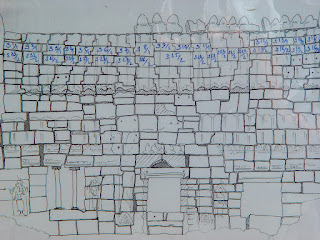 The work of preserving Angkor Wat – and many other temples – continues with the expertise of many nations.
However, not all the numerous temples in the Angkor region received the same focused attention as Angkor Wat. Even today, in temples where carvings are more exposed to weather, stone contours have softened and only the faintest images remain, moss coats surfaces, tiny plants thrive between blocks, and the webs of marauding spiders form gossamer veils. And in some temples it’s clear that restoration has been, at best, less than perfect – especially when Frangipani’s upper torso has lily’s navel - because sometimes reconstructions are completed with stone blocks that are available - rather than those that are missing.
 If you wander through the valleys, across the plains and over hillsides of the one-time Khmer Empire you'll get to meet many more of these apsara beauties, some as fresh and clean as if they were carved yesterday and others not. Their costumes and appearance change depending on the era in which the carvers gave birth to their creations. And there is something about them – some shared characteristic.
Apsara frequently hold flowers, or their diaphanous sarongs are discretely decorated with blossoms, and sometimes they are surrounded by elaborate carved foliage, or the background from which they protrude is a field of repetitive floral symbols.
Perhaps the most common flower represented is the sacred flower of Hindu mythology, the lotus and many apsaras hold a long stem lotus that loops behind their neck.
Every apsara is unique – some barely so - but others are like chalk and cheese. They all have as much variation in eyebrows, eyes, chins, lips and mouths, gestures, body shape, hairstyle, and apparel and accessories as you’d see as any crowded mall anywhere in the world.
I am told several hold books – and that only two, among all the smiles, display teeth - I can vouch that there is one. But I won’t tell you where she is – go look for yourself.
But what is it about them? There is a consistent feature. It’s on the tip of my tongue.
In my first post about apsaras I began by writing that many Asian women have extraordinarily exotic features – added to which they frequently wear clothing that tantalises – like the Chinese cheongsam and the Vietnamese ao dais, for example.
If you hang around you’ll be able to revisit the Khmer Empire, apsaras and the similarity they universally share, and beautiful women in another post some time soon.
Thanks for spending these few minutes with me.
And then I get to thinking about life in the western world and the cultural differences with Asia and I perk up because I realise that staying put in Australia, for me, is not an option; and anyway discovering Asia has been a joy, and I’m always excited at the chance to return there.
One rewarding discovery for me has been the ancient Khmer empire; I recall during my mid to late twenties reading about Pol Pot and Cambodia and I remember never being quite clear about the complex drama that was being played out; I don’t know that I ever resolved the conundrum.

Way back in a February post entitled Dames, Broads and Dolls, I wrote about apsara, celestial dancers, that adorn numerous khmer temples … and I’ve pondered on their similarity because no matter where you come across apsaras, there’s something about them – I’ve gazed at thousands. I’ve closely scrutinised hundreds of faces. There’s definitely something about them.
Georges Coedes, doyen of Khmer Empire academics until his death in 1969 wrote, ‘ … the figures of apsaras which adorn the walls of Angkor Wat are not there solely for the pleasure of the eye: their role is to transform this cold stone dwelling-place into a celestial palace’. So, it seems, he believed that these decorative girls – and all the other temple decorations - were more than simple representations of divine beings; rather he believed they were to evoke divine worlds and bring them to life - in the temple.
So imagine, night has fallen and beyond the outer temple enclosure in the jungle there is rustling, shrill cries, and throaty rumbling. Inside the temple, the great Khmer king Jayarvarman VII is making his way to the inner sanctum of Angkor Wat – his vast retinue of attendants follow although only he and the attending Brahman priests will climb to the highest terrace. The sound of the pacing thousands echo through the galleries and terraces.

Now the celestial dancers are not so inert – but rather they seem to seductively undulate, sway, and deeply genuflect - and the guardian devatas in deepening shadows alternately recede and emerge as flames flicker. Light gleams on vast golden Buddhas and Hindu deities. Bats zigzag and squeak. Bells and gongs ring, and other instruments tinkle. And fruit and blossom offerings scent the humid night.
The king strides the great encircling galleries with their carved reliefs - floating apsaras in heaven and tormented souls in hell – torture and mayhem – and scenes of the royal court - he pauses by an image his grand-father King Suryavarman II who commissioned this vast building, standing on his war elephant leading a vast army of Khmer and Siamese troops on its way to wage war – to kill and plunder, pillage and enslave.
If apsaras talked - and who knows maybe they do when the tourist hoards are gone - they would tell you they are accustomed to molestation and violence. They have been fondled by perhaps millions of visitors over hundreds of years, for centuries robbers have been hacking their inscrutable faces from shapely bodies to make a quick buck, and restoration works have deconstructed, chemically treated and reconstructed thousands.
The most recent apsara pogrom occurred in temples where Pol Pot’s armed thugs took refuge between 1975 and 1979 amusing themselves using life-sized apsaras for target practice. Happily, by and large, they otherwise left the temples relatively unharmed – a miracle given what the Khmer Rouge did to fellow citizens – these acts of temple vandalism were the very least of their mindless activities.

Fortunately, in the early nineteen-eighties the Archaeological Survey of India – the ASI - was selected to undertake Angkor restoration works; their proposals were accepted because of their sympathy with Khmer culture and similar work done on many Indian temples.
The scale of the renovation works was staggering – entire portions of the temple were rebuilt – or at least renovated. Bat nesting was eliminated and the stone-corroding acid from their droppings was neutralised. Micro-vegetation was stripped away. Damaged stones were rejuvenated. Surfaces were chemically cleaned, and protected. And inevitably, fortunately, the apsaras received the same TLC – which is why their smiles are broader than any other Angkor apsaras. Yes, you’re right – that’s not true – but it would be nice to think it was, given the difficulty involved in the restoration.
Like the ugly duckling that became a swan - Angkor Wat was transformed; and all this was achieved as a, post Pol Pot regime, civil war raged around Angkor. India’s Ambassador to Cambodia later wrote: ‘There was no electricity, no health facilities, no communication with the outside world. In short, the working conditions were extreme. But for seven to eight months at a stretch for seven consecutive years from December 1986, the ASI experts spent all their energies in saving Angkor Wat, shoulder to shoulder with their Khmer brethren’.

However, not all the numerous temples in the Angkor region received the same focused attention as Angkor Wat. Even today, in temples where carvings are more exposed to weather, stone contours have softened and only the faintest images remain, moss coats surfaces, tiny plants thrive between blocks, and the webs of marauding spiders form gossamer veils. And in some temples it’s clear that restoration has been, at best, less than perfect – especially when Frangipani’s upper torso has lily’s navel - because sometimes reconstructions are completed with stone blocks that are available - rather than those that are missing.

Apsara frequently hold flowers, or their diaphanous sarongs are discretely decorated with blossoms, and sometimes they are surrounded by elaborate carved foliage, or the background from which they protrude is a field of repetitive floral symbols.
Perhaps the most common flower represented is the sacred flower of Hindu mythology, the lotus and many apsaras hold a long stem lotus that loops behind their neck.
Every apsara is unique – some barely so - but others are like chalk and cheese. They all have as much variation in eyebrows, eyes, chins, lips and mouths, gestures, body shape, hairstyle, and apparel and accessories as you’d see as any crowded mall anywhere in the world.
I am told several hold books – and that only two, among all the smiles, display teeth - I can vouch that there is one. But I won’t tell you where she is – go look for yourself.
But what is it about them? There is a consistent feature. It’s on the tip of my tongue.
In my first post about apsaras I began by writing that many Asian women have extraordinarily exotic features – added to which they frequently wear clothing that tantalises – like the Chinese cheongsam and the Vietnamese ao dais, for example.
If you hang around you’ll be able to revisit the Khmer Empire, apsaras and the similarity they universally share, and beautiful women in another post some time soon.
Thanks for spending these few minutes with me.
Saturday, 18 June 2011
Maturity is no antidote against stupidity!
So this morning as I clamber from my bed I know with a certainty that I consumed too much alcohol last night. Way too much. Stupid. Absurd.
So in my fragile state I’m tapping away at this post because I’ve missed blogging in recent months, and because my own stupidity reminds me that I have thoughts I’d like to share about this very subject.
Stupidity. I’m not sure about your world, but mine really is full of breathtaking stupidity.
More and more I see ordinary citizens of the world in which I live being treated like helpless children despite their obvious maturity; or like criminals instead of hapless innocents trapped in a mire of revenue-raising regulations; or heroes when they should be perceived as villains; or wealthy when in fact they are just making ends meet as taxes and the cost of living soar; or intellectuals when they are nothing more than pompous and misguided blowhards. I won’t go on, at 68 time is too short.
In previous posts I’ve identified my ‘PC21’ - my personal conflicts with the twenty-first century - and this list perfectly illustrates some of the conflicts that often cause me to feel disenfranchised, as stupidity gets a tighter and tighter grasp on society, and as it slowly strangles my own ability to live my very modest and unobtrusive lifestyle.
Since I last posted I’ve spent some time in my Thai home; living in a third world country is a welcome reprieve from western society.
But I've also spent some time in corporate Australia and there’s certainly no escape from stupidity there. Less people doing more and more work, multitasking our way to mediocrity while all the time loudly proclaiming corporate values of quality and thought leadership; eliminating competent employees and then immediately replacing them with more educated but less competent and capable people - qualifications are rarely a substitute for experience; demands for increased productivity and quality while acting in ways that reduce worker engagement; shunting people around organisational structures that on paper work perfectly, but in the real world defy implementation; English-mangling jargon that makes the simple incomprehensible; it’s a place where talking in meetings eliminates any possibility to doing; and, in my own area of specialisation, we’re trying to turn selling into a science rather than mastering the art.
This is unquestioningly the age of absurdity. But there’s not much point whining - better to fight back. But what to do? What weapons do I have against this global tsunami of absurdity? Or do I have a shield large enough to protect me?
Well, I’ve already posted the steps that I’ve taken to try and counter my personal conflicts with this century.
And recently I’ve been trying to make sense of this age, and trying to discover whether others have similar frustrations to my own, so I’ve been reading ‘The age of absurdity’; for me it’s riveting and if you find yourself wondering what has happened to life as you once knew it, then this is a book for you.
 It’s one of the few paperbacks I have, given the transient nature of my lifestyle, and its pages are scored with underlined paragraphs and graffiti, pages are dogeared, it falls open at many places where the spine has been creased, and it has post-it notes and scraps of paper poking out between every other page.
If you sense that you are in conflict with the twenty-first century I highly recommend you read ‘The age of absurdity’ and react, and resist some of the nonsense that threatens to overwhelm us.
Reading it has certainly helped me see the absurdity - the stupidity - that pervades our society and it’s given me great new insights that help me stiffen my resolve to resist.
How to resist? What to do? It’s tough because the absurdity of this age is omnipresent. But on a practical level here’s my discipline:
By applying these disciplines I don’t eliminate absurdity, but I do cause my focus to be on what I am doing, rather than what everyone else is doing; and that works for me.
As is self evident, Buddha accompanies me on this journey of reflection and in an early post I wrote that it was ‘my growing conviction is that there could be no better guide, no better plan, for responding to pc21, than the way for living life as proposed by the Buddha’; his eightfold path is a very accessible tool for living.
Author Michael Foley writes in the ‘The age of absurdity’ opening chapter, that ‘Buddha’s metaphor for the liberated mind was a sword drawn from its scabbard’ - so perhaps Buddha’s image and my self-professed role as an aging warrior are entirely appropriate for trying to liberate myself from this age of absurdity?
And perhaps maturity can be an antidote to absurdity - and stupidity?
http://www.amazon.com/Age-Absurdity-Modern-Makes-Happy/dp/1847396275/ref=sr_1_1?s=books&ie=UTF8&qid=1308383280&sr=1-1
So in my fragile state I’m tapping away at this post because I’ve missed blogging in recent months, and because my own stupidity reminds me that I have thoughts I’d like to share about this very subject.
Stupidity. I’m not sure about your world, but mine really is full of breathtaking stupidity.
More and more I see ordinary citizens of the world in which I live being treated like helpless children despite their obvious maturity; or like criminals instead of hapless innocents trapped in a mire of revenue-raising regulations; or heroes when they should be perceived as villains; or wealthy when in fact they are just making ends meet as taxes and the cost of living soar; or intellectuals when they are nothing more than pompous and misguided blowhards. I won’t go on, at 68 time is too short.
In previous posts I’ve identified my ‘PC21’ - my personal conflicts with the twenty-first century - and this list perfectly illustrates some of the conflicts that often cause me to feel disenfranchised, as stupidity gets a tighter and tighter grasp on society, and as it slowly strangles my own ability to live my very modest and unobtrusive lifestyle.
Since I last posted I’ve spent some time in my Thai home; living in a third world country is a welcome reprieve from western society.
But I've also spent some time in corporate Australia and there’s certainly no escape from stupidity there. Less people doing more and more work, multitasking our way to mediocrity while all the time loudly proclaiming corporate values of quality and thought leadership; eliminating competent employees and then immediately replacing them with more educated but less competent and capable people - qualifications are rarely a substitute for experience; demands for increased productivity and quality while acting in ways that reduce worker engagement; shunting people around organisational structures that on paper work perfectly, but in the real world defy implementation; English-mangling jargon that makes the simple incomprehensible; it’s a place where talking in meetings eliminates any possibility to doing; and, in my own area of specialisation, we’re trying to turn selling into a science rather than mastering the art.
This is unquestioningly the age of absurdity. But there’s not much point whining - better to fight back. But what to do? What weapons do I have against this global tsunami of absurdity? Or do I have a shield large enough to protect me?
Well, I’ve already posted the steps that I’ve taken to try and counter my personal conflicts with this century.
And recently I’ve been trying to make sense of this age, and trying to discover whether others have similar frustrations to my own, so I’ve been reading ‘The age of absurdity’; for me it’s riveting and if you find yourself wondering what has happened to life as you once knew it, then this is a book for you.

If you sense that you are in conflict with the twenty-first century I highly recommend you read ‘The age of absurdity’ and react, and resist some of the nonsense that threatens to overwhelm us.
Reading it has certainly helped me see the absurdity - the stupidity - that pervades our society and it’s given me great new insights that help me stiffen my resolve to resist.
How to resist? What to do? It’s tough because the absurdity of this age is omnipresent. But on a practical level here’s my discipline:
- I try to simplify my thinking - and eliminate or reduce the mental muddle that often accompanies anything we do in this age, and
- I try to focus on doing everything with complete attention rather than multitasking myself into mediocrity, and
- I try to eliminate or avoid sources of information, like newspapers, that cause me to confront the absurdity, and
- I try to avoid accumulating.
By applying these disciplines I don’t eliminate absurdity, but I do cause my focus to be on what I am doing, rather than what everyone else is doing; and that works for me.
As is self evident, Buddha accompanies me on this journey of reflection and in an early post I wrote that it was ‘my growing conviction is that there could be no better guide, no better plan, for responding to pc21, than the way for living life as proposed by the Buddha’; his eightfold path is a very accessible tool for living.
Author Michael Foley writes in the ‘The age of absurdity’ opening chapter, that ‘Buddha’s metaphor for the liberated mind was a sword drawn from its scabbard’ - so perhaps Buddha’s image and my self-professed role as an aging warrior are entirely appropriate for trying to liberate myself from this age of absurdity?
And perhaps maturity can be an antidote to absurdity - and stupidity?
http://www.amazon.com/Age-Absurdity-Modern-Makes-Happy/dp/1847396275/ref=sr_1_1?s=books&ie=UTF8&qid=1308383280&sr=1-1
Subscribe to:
Posts (Atom)